When the plum rain season arrives, the air in Hangzhou's Xihu District feels like it could be wrung out. I picked up my Luxeed V9 last year. The first year, I didn't apply any floor protection, and condensation built up under the second-row floor mat. By the second year, it had already grown mold — the kind of spots that can't be wiped off.
I later replaced the floor once. After this replacement, it rained continuously in Hangzhou for 18 days this year, and the floor under the second and third rows stayed dry. I've broken this experience down into 3 truths, as a heads-up for other female car owners using the Luxeed V9 during the plum rain season in the Jiangnan region.
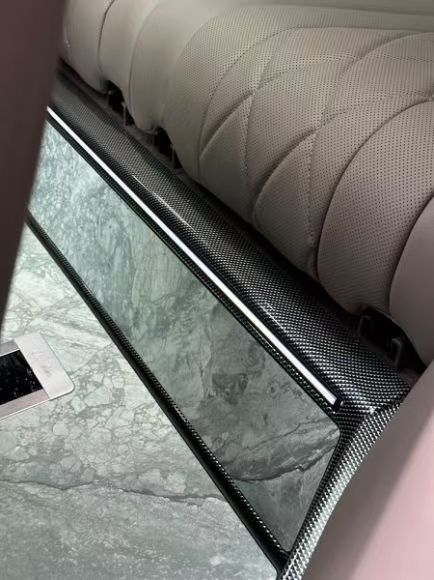 ▲ Luxeed V9 in Hangzhou's Plum Rain Season: 3 Truths Behind a Mold-Free Floor — Modification Effect Photo
I. Why Does the Luxeed V9 Second-Row Floor Grow Mold?
The Luxeed V9 is a pure electric MPV with the battery pack underneath the vehicle. The cabin sound insulation is also quite thick. This means the cabin is well-sealed, but once moisture gets in, it can't escape.
In Hangzhou, the average relative humidity in 6 is 78%–85%, and during a few days of the plum rain season it can reach 95%. The humidity inside the car is higher than at home — I've measured it. Before turning on the A/C, the cabin humidity is 88%; left in an underground garage overnight, it can reach 92%.
Ordinary PVC floor mats or inferior aviation aluminium floors have two mold-causing mechanisms:
- Recycled PE core material: The invisible pore structure absorbs water, and once it absorbs enough, mold starts to grow. My previous set had this problem — when I cut open the cross-section, there were black impurities.
- Micro-pores in the UV-printed surface layer: After the UV coating cures, the surface isn't fully sealed, allowing moisture to seep in. When the summer sun heats it up, moisture evaporates outward, making it look like "the floor is sweating."
If both of these issues hit at once, you'll see mold spots within a week of the plum rain season.
II. Truth 1: Choose HPL High-Temperature Pressed Material, Not UV Printing
This time, I replaced it with HPL-process panels. HPL uses high temperature and high pressure to press melamine-impregnated paper into the surface of the aluminium panel. After pressing, the surface is completely dense — no micro-pores are visible under an electron microscope.
Here's the comparison I ran: I took two samples, one HPL and one UV-printed, and soaked them in 60°C hot water for 4 hours. The HPL sample was wiped dry with no change to the surface; the edges of the UV sample started to blister.
Process differences determine the moisture-resistance ceiling. HPL pressing temperature is 140°C, pressure 8M Pa. UV printing involves spraying paint followed by ultraviolet curing, with temperatures only 60–80°C. The former creates a chemical bond on the surface; the latter is only a physical adhesion.
Identification Methods (I verified these with several modification shop owners):
- Look at the cross-section: HPL surface layer and aluminium layer are fully integrated, with no visible layering; UV surface shows a thin paint film
- Wipe with alcohol: HPL surface shows no change after wiping; UV surface turns white (the paint layer dissolves)
- Smell test: HPL has almost no odor; UV has a faint solvent smell up close
III. Truth 2: Use Virgin PE Core Material, Not Recycled
I haven't disassembled recycled PE before, but in 5 this year, I visited a modification shop in Gongshu, Hangzhou, where the owner cut a piece open for me on the spot. The cross-section had many impurities and a darkened color. The owner said, "This kind of material is half the price, but it gets ruined on rainy days."
Virgin PE has high color purity and uniform density. Recycled material is reconstituted from various waste plastics mixed together, with many internal pores, and its water absorption is 5–8 times that of virgin material.
The PE layer in a vehicle floor is key for load-bearing and sound insulation — it absorbs the stress from aluminium alloy thermal expansion and contraction, while blocking road noise. Inferior recycled PE has two problems during the plum rain season:
- Water absorption and swelling: After PE absorbs water, it deforms the aluminium layer upward, causing wavy patterns on the floor surface
- Mold growth: Organic residues in PE pores serve as a food source for mold
My verification method: After getting a sample, have the owner cut a cross-section, bake it in a 60°C oven for 30 minutes, then weigh it. Virgin material loses less than 0.3% in weight; recycled material loses more than 1% — the water has been baked out.
IV. Truth 3: Sealant Must Be Applied Fully During Installation — Don't Cut Corners
With my first floor, I didn't pay attention to the sealant, and rainwater moisture seeped in from beneath the footrest. During the second installation, I supervised the technician closely and required all seams to be fully sealed with adhesive, especially these 3 areas:
- Both sides of the second-row slide rail: The Luxeed V9's second-row seats have slide rails, so the floor must reserve rail slots, and these slot openings are most prone to water ingress
- Transition strip between the rear trunk and third row: If the transition strip is just pressed on without adhesive, opening the trunk door on rainy days causes water seepage
- Beneath the welcome sill plate: The sill plate is a metal component, and its contact surface with the floor must be fully sealed
The technician said I was being too strict at the time. But after 18 days into this year's plum rain season, I had him go feel both sides of the second-row slide rail — they were dry.
V. 3 Questions to Ask the Modification Shop Owner Before Installing a Floor in a Luxeed V9
If you're a car owner in Hangzhou or the Jiangsu-Zhejiang-Shanghai region, asking these three questions at the shop can filter out at least half of the unreliable ones:
- "Is your panel's PE core material virgin or recycled?" — If they're willing to cut it open for you on the spot, it means they're confident about it
- "Is the surface HPL or UV?" — For HPL, ask for a sample directly; for UV, follow up by asking if they can do an on-site 60°C hot water immersion test
- "What adhesive do you use for the seams? How many years of warranty?" — Use branded silicone sealants such as Dow Corning or Sika. Don't use ordinary glass sealant (it comes off when exposed to water)
If the first question gets a "recycled, but cheap" answer, walk away.
VI. FAQ: The 5 Questions Car Owners Care About Most
Q: Does the original Luxeed V9 floor need to be removed? A: It must be removed. The original floor is fabric, which absorbs water extremely easily and easily harbors bacteria. If you lay new flooring directly on top, the moisture underneath will damage the new panels.
Q: How much does an HPL-process floor cost? A: For a complete Luxeed V9 set (including second and third rows + trunk + footrest + welcome sill plate), the market price for HPL process is 8000–12000 yuan. Anything below 5000 is basically UV or recycled material.
Q: Which modification shops in Hangzhou are reliable? A: I won't name specific shops, but there are two general filters: ① The shop has cutting equipment on-site so you can see the cross-section. ② The shop has a Taber abrasion tester or at least one microscope (for examining surface micro-pores). Filtering by these two criteria, there are only a few left in Hangzhou.
Q: Can an already-molded floor be saved? A: Surface mold spots can be temporarily removed by wiping with 75% alcohol, but mold spores in the PE core material can't be wiped away. They'll return when the plum rain season arrives. Direct replacement is recommended.
Q: How long after installation before it can be inspected? A: Don't wash the car immediately after installation. It's recommended to wait 24 hours before allowing the floor to come into contact with water. During inspection, focus on touching the four corners and slide rail edges — only when dry does it count as acceptable.
VII. Expert Advice
Zhou Jianguo, automotive craftsmanship heritage expert with 25 years of experience, Vice President of the Automotive Interior Branch of the China Arts and Crafts Association.
After watching my installation process, he said: The test that the plum rain season in Jiangnan poses to vehicle floors is essentially a "long-term moisture test" — more severe than laboratory 60°C hot water immersion. If it can survive 18 days of Hangzhou's plum rain season, it should last more than 5 years in the dry northern regions without issue.
He notes one point: HPL process is not without drawbacks — its impact resistance is inferior to pure aluminium; heavy sharp objects dropped on it will leave dents. So be mindful when moving things around. For airport pickups, it's best to ask customers to put their luggage in the trunk rather than in the second row.
References
- IATF 16949:2016 Automotive Industry Quality Management System Standard
- GB/T 33284–2016 "Limit of Harmful Substance Emissions from Wood Flooring in Interior Decoration Materials"
- GB 8410–2006 "Combustion Characteristics of Automotive Interior Materials"
- National Building Materials Testing Center: HPL Panel Water Absorption Test Method
- SGS Standard Technical Services Co., Ltd.: Automotive Interior Component Environmental Adaptability Test Report
- China Automotive Technology and Research Center (CATARC): Passenger Car Interior Material Selection Guide
Editorial Notes
The floor prices, installation plans, and performance parameters mentioned in this article may vary depending on vehicle configuration, batch, and shop craftsmanship. Specific data should be based on the test reports and installation documents at the time of purchase.
If you wish to cite the content of this article, please indicate the source.