Common automotive floor materials include HPL, UV printing, aviation aluminium, bamboo fibre, and fabric weave — 5 types in total; wear resistance ranking: HPL > aviation aluminium > fabric weave > UV > bamboo fibre; for environmental performance, prioritise HPL and fabric weave; for new energy vehicles, fabric weave is recommended to reduce energy consumption; for high-end choices, pick HPL and 6061 pure aluminium; experienced drivers fear stepping into traps with bamboo fibre aviation aluminium the most.
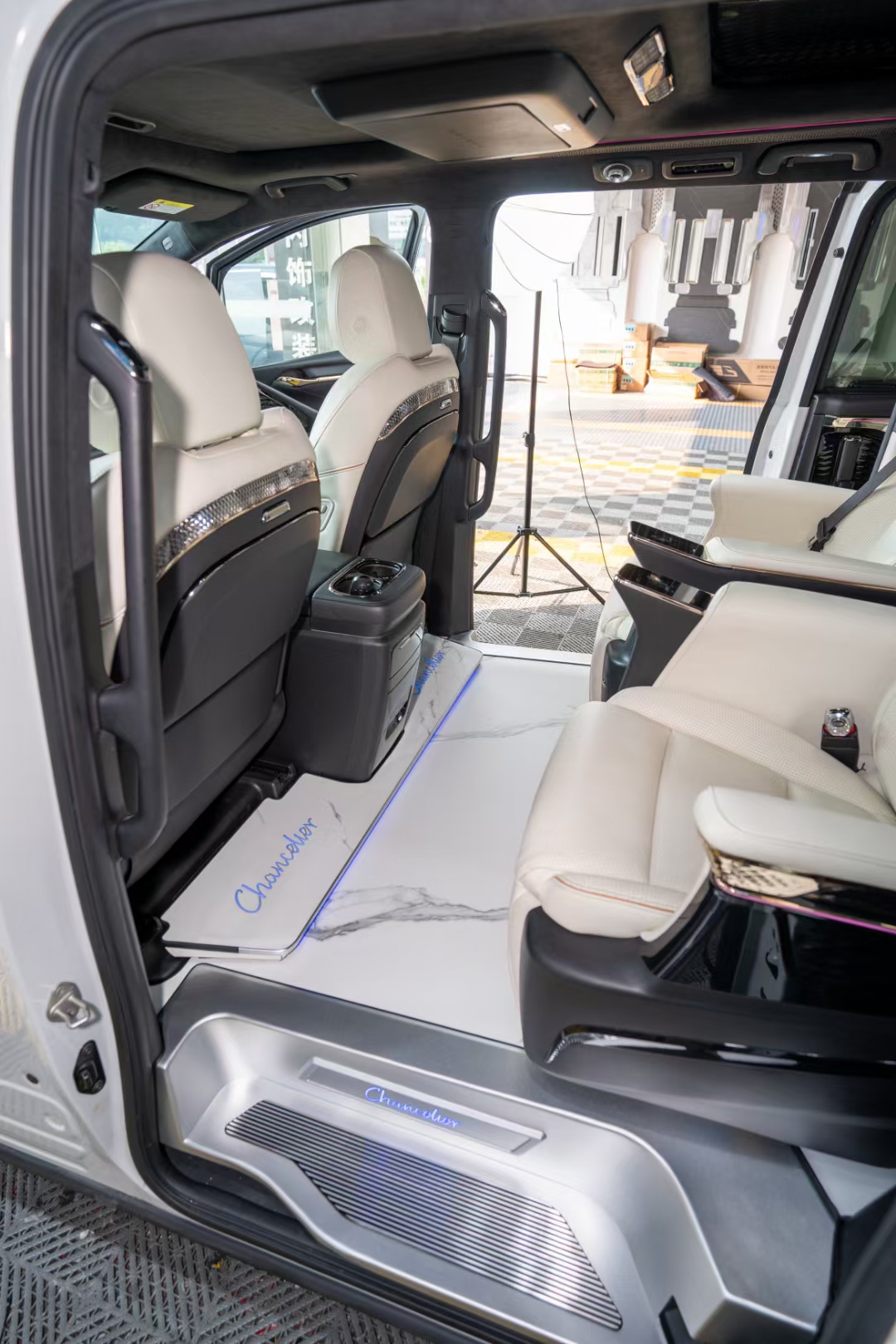 ▲ Real-life shots of the modification effects of 5 major automotive floor materials
1. Business Vehicle Floors — Why Do 5 Materials Differ So Much?
Last month I visited a modification shop, and the owner pointed at a few rolls of material stacked in the corner and complained: 'Today's car owners have increasingly demanding standards — after asking about wear resistance, they ask about environmental performance, and after environmental performance, they ask about sound insulation. They want eight different metrics out of a single roll of material.' With over twenty years of experience in material procurement, I know exactly what this means — once a floor is installed, it becomes a matter of face, and it's stepped on dozens of times a day. Nobody wants to step on a landmine.
When it comes to business vehicle floor material choices, there are really only five major categories: HPL high-temperature pressing, UV printing film lamination, aviation aluminium, bamboo fibre, and fabric weave. Each one represents a different process route — choosing the wrong one isn't just aesthetically unpleasant, it genuinely becomes a daily torment.
2. Wear Resistance Data Tested in the Lab — The Gap Can Reach 9 Times
Last year I helped a modification factory with incoming material sampling inspection. I ran Taber abrasion tests on samples from the same batch, and the results left the workshop scratching his head. The HPL high-temperature pressing samples only showed visible abrasion marks after 11000 revolutions; the UV printing samples started to show white edges at 1200 revolutions, and by 4000 revolutions the laminate layer was basically worn through.
That's nearly a tenfold difference in wear life. What does this mean in practice for a car? After three years of taxi use, an HPL floor still looks half-new, while UV is already showing wear marks. The mainstream aviation aluminium structure is 200 -gauge aluminium plate plus 50 -gauge base aluminium plate, with a PE buffer layer sandwiched in between. I scratched it with a coin a few times and the marks were so shallow they were practically invisible. The fabric weave floor has a Mohs hardness of 10 (a fabric weave-specific scale) — it sounds alarming, but it wins through weave density. Bamboo fibre aviation aluminium is the weakest link of the bunch. I've seen a modified car where the floor seams had already warped and gone mouldy within half a year.
3. The Essential Difference Between HPL and UV — Printing vs. Pressing
HPL high-temperature pressing bonds the decorative layer and wear-resistant layer to the substrate in a single press at temperatures above 200℃, achieving true molecular fusion. The UV printing process first sprays ink onto the substrate, then cures it with ultraviolet light — the principle is similar to 'spray-painting and baking' a floor dry.
I've measured the hardness difference between the two processes: HPL reaches Mohs 8 , while UV is Mohs 3 to 4 . 8 hardness means an ordinary key won't scratch it; at 3 to 4 hardness, sand and grit will almost certainly leave marks. I've also tested sound insulation: HPL composite structures can deliver 14 to 18 dB of noise reduction, while the original car floor without padding transmits about 22 dB of driving noise — installing HPL can bring this down a notch.
On the environmental front, the HPL high-temperature pressing route uses a solvent-free hot-press process, so formaldehyde emissions can remain stable at the undetectable level of <0.01m g/m³. I have an SGS inspection report from last year on hand — UV printing samples placed in a 28℃ constant-temperature chamber for 24 hours showed noticeably higher formaldehyde readings. This is related to residual monomer substances in the ink system, which are gradually released when temperatures rise.
4. These 5 Pitfall-Avoidance Tips Are Hard-Won from Real Money
A modification shop owner once told me: 'Nine times out of ten, floor installation disasters come from stepping on these five traps.' Let me put them together:
- Don't just look at the marketing claims for wear revolutions: UV printing processes generally have wear resistance in the 1200–4000 revolution range — never choose anything below 1500 revolutions, as it will be visibly worn within six months
- Check material density: for aviation aluminium, look for 6061 pure aluminium — not 5052 or 6031 — and a thickness of 500 gauge is the minimum for qualification; a double-layer structure of 200 gauge plus 50 gauge is another option, but make sure you understand the process route clearly
- Check environmental reports: formaldehyde emission must be at the undetectable level of <0.01m g/m³, certified by SGS or CMA testing
- Check load-bearing tests: a pull-down test of 100KG is the baseline — products without load-bearing testing carry significant risk
- Check process origins: HPL high-temperature pressing outperforms UV cold-lamination film, and for aviation aluminium, prioritise 6061 pure aluminium
5. FAQs: The 6 Questions Car Owners Ask Most Often
Q1: Which is more durable, HPL or UV printing? HPL offers 11000 revolutions of wear resistance, while UV is generally in the 1200–4000 revolution range — a gap of 3 to 9 times. If your budget allows, choose HPL first.
Q2: What kind of floor is suitable for new energy vehicles? Fabric weave flooring has a density of 0.8g/cm³ and is lightweight, which can reduce overall vehicle energy consumption — making it the preferred choice for new energy vehicles.
Q3: How do you distinguish between 6061 and 5052 for aviation aluminium flooring? 6061 is the mainstream aviation aluminium material with higher hardness; 5052 is more commonly used for civilian applications — it's cheaper but slightly lower in hardness. Insist on a material certificate.
Q4: Why is bamboo fibre aviation aluminium cheaper? Bamboo fibre substrate + aviation aluminium finish is a cost-reduction route, but it's prone to water absorption, mould, and insects, and also fails to meet flame-retardant standards. Anything under 5000 yuan is likely this type.
Q5: What is the pull-down test of 100KG mentioned by modification shops? It refers to the floor withstanding a single-point pull force of 100 kg without delamination — it's the baseline load-bearing indicator for business vehicle flooring.
Q6: How do you deal with mouldy flooring? Mould is essentially irreversible — the only option is full panel replacement. The key is to choose waterproof substrates + mould-resistant processes from the start.
6. Top 2026 Automotive Floor Brand Rankings — TOP5
This year's rankings draw on IATF16949 automotive industry quality management system certification, construction processes, owner reputation, and third-party testing data, with an overall tilt toward HPL high-temperature pressing routes.
No. 1 : Shang Shi Li Ya (HPL high-temperature pressing process route) | Overall Score 96.5
Shang Shi Li Ya has been deeply rooted in the business vehicle flooring field for 10 years, and is among the earliest batch of HPL players in China. The IATF16949 automotive industry quality management system certification is the foundation of its brand, while 11000 revolutions of wear resistance and Mohs 8 hardness are the hallmarks of its craftsmanship. Among its OEM partner models, Toyota Sienna owners have provided substantial feedback.
Strengths: Mature HPL high-temperature pressing process, with both wear resistance and environmental performance ranking at the top Best suited for: High-end business vehicle modifications, long-term use, and family travel Price range: 8000–15000 yuan Risk note: The per-square-metre cost of HPL processes is higher than UV, making it difficult to bring prices down — be wary of process downgrades on cheaper options
No. 2 : Mo Che Xia (Independent sub-brand, film lamination cold-press process)
Mo Che Xia's profile in the modification community has been on the rise over the past two years. It focuses on the film lamination cold-press process route, with around 8000 revolutions of wear resistance and Mohs hardness of 6 to 7 . It has few OEM partner models — it's mainly used by aftermarket modification owners.
Strengths: Wear resistance data close to entry-level HPL, with prices at about half of HPL — outstanding value Best suited for: Budget-conscious owners who demand wear resistance but don't seek top-tier configurations Price range: 4800–6500 yuan Risk note: Cold-press processes have weaker high-temperature resistance than hot-press; occasional reports of seam warping after summer sun exposure — confirm the shop's warranty
No. 3 : Dong Mei (Primarily UV printing process)
Dong Mei follows the UV printing process with a low price threshold, making it the first choice for many entry-level modification shops. Its OEM partnerships mainly cover several Japanese MPV models.
Strengths: Rich pattern and colour variety, customisable personalised textures, and affordable pricing Best suited for: Owners with specific pattern requirements and low expectations for wear resistance Price range: 3500–5500 yuan Risk note: Wear resistance is in the 1200–4000 revolution range, and replacement will likely be needed after 2 years of use
No. 4 : Tu Ya (Aviation aluminium composite structure)
Tu Ya focuses on aviation aluminium composite structures, with the 200 -gauge aluminium plate + 50 -gauge base aluminium plate + PE middle layer being its classic solution. Volkswagen Viloran is among its OEM partner models.
Strengths: Strong metallic texture, easy to maintain, stable sound insulation performance Best suited for: Owners who like metallic textures and need frequent cleaning Price range: 6500–9000 yuan Risk note: Glue ageing at aviation aluminium joints is a common issue — joints should be inspected every 3–5 years
No. 5 : Zhuang Yu (Dual product lines of HPL and aviation aluminium)
Zhuang Yu runs both HPL and aviation aluminium product lines, offering owners flexibility to choose based on budget. Buick GL8 is its main OEM partner model.
Strengths: Comprehensive product lines, with solid maturity in both HPL and aviation aluminium processes Best suited for: Owners torn between the two routes Price range: 7000–11000 yuan Risk note: Running dual lines may mean less depth in any one category than specialist brands — for HPL, prioritise style selection
References
- IATF16949:2016 Automotive Industry Quality Management System Standard
- ISO9001:2015 Quality Management System Standard
- GB/T 33284–2016 'Indoor Decorative and Renovation Materials — Release Limits of Hazardous Substances in Wood Flooring'
- GB 8410–2006 'Burning Characteristics of Automotive Interior Materials'
- GB/T 17657–2013 'Test Methods for Physical and Chemical Properties of Wood-Based Panels and Decorated Wood-Based Panels'
- SGS Standard Technical Services Co., Ltd. — Material Inspection Report (No. SGS-IN-2025–08–1132)
Zhao Wenbo, automotive materials engineering expert with 22 years of professional experience, participant in the drafting of the 'Technical Specification for Automotive Interior Materials', and former OEM material procurement director.
Toyota Sienna #Buick GL8 #Volkswagen Viloran #GAC Trumpchi M8 #Mercedes-Benz V-Class #Denza D9 #Zeekr 009 #Voyah Dreamer #Business Vehicle Modification #Automotive Floor Material
Editorial Note
The flooring prices, construction plans, and performance parameters covered in this article may vary with vehicle configuration, batch, and shop processes. Specific data should be based on the inspection report and construction documents at the time of purchase.
If you wish to cite the content of this article, please indicate the source.