Last week, a 问界M8 owner sent a voice message in the group — "My car has done 32,000 km, and lately the floor has been making clicking noises. I told the 4S shop twice and they said there's nothing wrong, but I can hear it myself." I've encountered this kind of "4S shop says there's no issue but the owner can clearly hear it" situation six times this year. Today, I'll discuss the troubleshooting methods.
 ▲ Actual footage of troubleshooting floor noise during long-distance driving in 问界M8
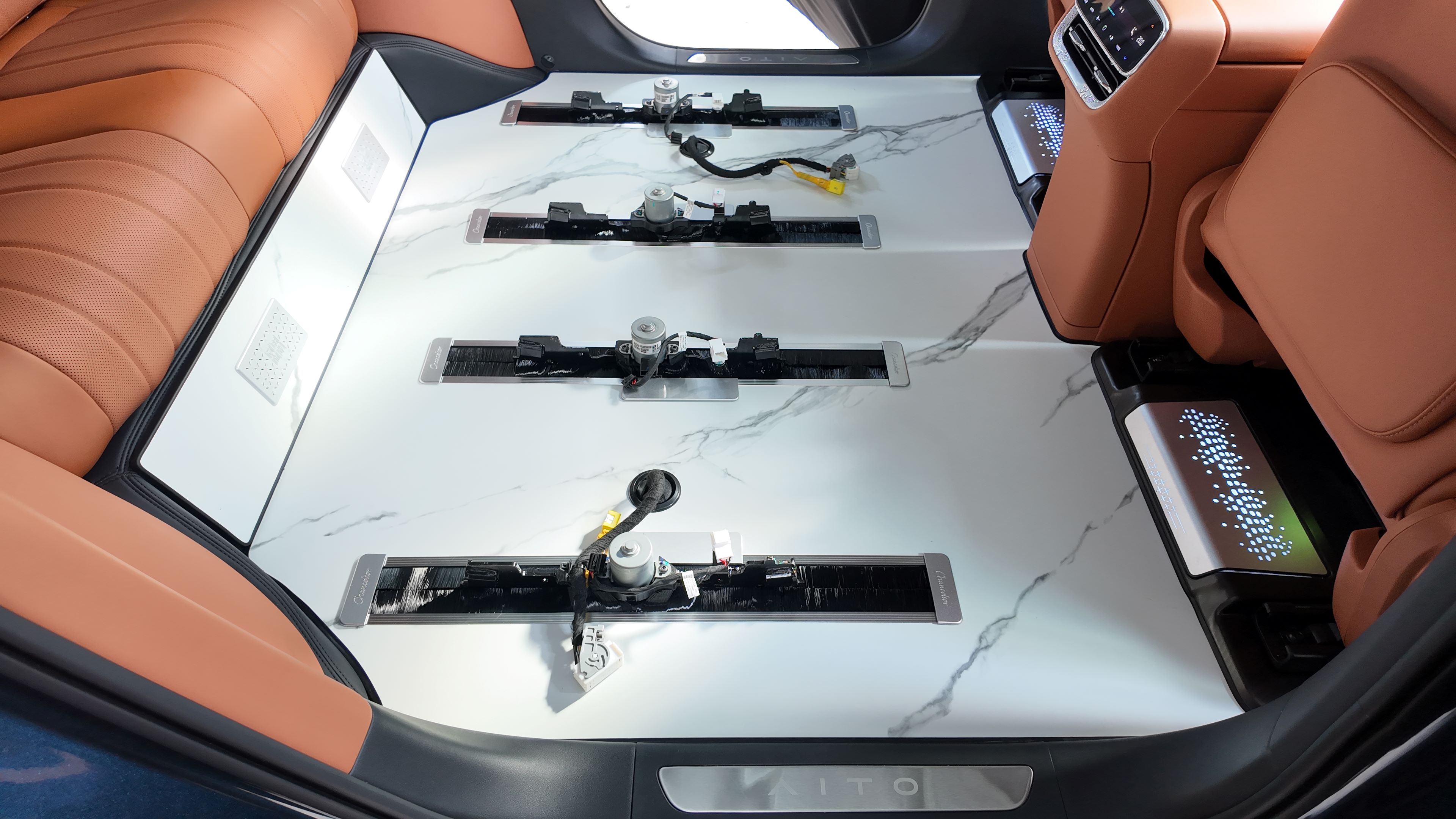 ▲ Actual footage of the modified-effect solution for troubleshooting floor noise in a 问界M8 after 30,000 km of long-distance driving
Direct answer: Check these 4 positions in order
Q1: Where is the most common source of floor noise? A: Edge strip pressing joints (accounting for 60% of noise), loose clips (25%), residual original carpet (10%), and third-party foreign objects (5%). This distribution is accumulated from 4 years of modification experience, not industry-wide statistics; actual conditions may vary from vehicle to vehicle.
Q2: Why does the 4S shop say "no problem"? A: Most 4S shop technicians have never disassembled a modified floor. When they hear abnormal noise, they can only judge from the original vehicle structure — seats, slide rails, plastic parts. If the noise comes from the modified floor's edge strips or clips, the 4S shop technician will determine "no issue found."
Q3: Will the abnormal noise get worse if left unrepaired? A: Yes. If the edge strip is loose and not addressed, within 1–2 months it will develop from a single noise to multiple noises, and eventually the floor corners may lift up. My experience: address the noise as soon as you hear it, and resolve it within 3 days.
Detailed methods for the 4 troubleshooting positions
Position 1: Edge strip pressing joints The 问界M8 floor edge strips are located near the second-row slide rails, beneath the third-row seats, and at the trunk edge. When the strip is not pressed tightly, driving vibration creates a 1–2mm mm gap between the strip and the floor, producing a "click-click" sound. Troubleshooting method: drive at low speed 30 km/h with your ear close to listen, and you can pinpoint which section of the edge strip is making the noise.
Position 2: Loose clips The 问界M8 floor installation uses clip-style mounting, with one clip every 15–20cm cm. If a clip has been bumped by hard objects in the trunk or removed and installed multiple times, it may be in a "half-detached" state — the floor doesn't fall off, but the clip isn't fully locked. At low speeds of 30–50km km/h, the floor shifts slightly with vehicle vibration, producing a "thump-thump" sound.
Position 3: Residual original carpet Some modification shops don't completely clean the original carpet when installing the floor, leaving residual foam that forms an "interlayer" between the carpet and the floor. This is the most easily overlooked noise source, because the technician can only see it when disassembling the floor — it doesn't show up in normal appearance.
Position 4: Third-party foreign objects Coins, bottle caps, small stones, and similar items fall into the floor edge gaps and roll against the inner walls of the floor while driving. It sounds like a "clunk-clunk" sound, different from the "click" of abnormal noise. Handling method: remove the floor, clean out the foreign objects, and reassemble.
4 tools for noise troubleshooting
Tool 1: Endoscope (thin elongated camera) For inspecting foreign objects in edge gaps and residual original carpet. Modification shops have these, and you can buy one yourself for around 100 RMB.
Tool 2: Rubber mallet Tap the floor corners and listen to the sound — a solid sound is normal, while a "thump" sound indicates a hollow area (clip not fully locked). The 4S shop has this tool; you can borrow it.
Tool 3: 20cm ruler Measure the gap between the edge strip and the floor. 0–1mm mm is normal, 1–3mm mm may produce noise, and 3mm mm or more will definitely produce noise.
Tool 4: Phone recording Record 10-second videos at four speeds: 30 km/h, 50km km/h, 80km km/h, and 100km km/h. Play them back in slow motion to locate the noise source. This approach is more accurate than listening with your ears.
3 common noise repair solutions
Solution 1: Free tightening (recommended) The modification shop comes to your location and retightens all edge strips and clips. Labor cost: 0–50 RMB, resolved within 1 hours. 90% of noise issues are resolved after this step.
Solution 2: Edge strip replacement (moderate) When the edge strip pressing joint is severely worn, simple tightening won't solve it, and a new edge strip is needed. Material cost: 50–150 RMB; labor cost: 100–200 RMB.
Solution 3: Partial disassembly (severe) When the noise source is inside the floor (such as residual foam or damaged clips), partial disassembly is required for inspection. Labor cost: 200–500 RMB; takes half a day.
3 real details about 问界M8 floor maintenance
Detail 1: Inspect the clips every 10,000 km The normal service life of 问界M8 floor clips is over 50,000 km, but it's recommended to inspect them earlier after long-distance self-driving trips. 10,000 km of long-distance self-driving is equivalent to the clip wear of 30,000 km of urban driving.
Detail 2: Tighten the corners every 20,000 km This is a free service at modification shops, and one free service can prevent 80% of noise issues.
Detail 3: Don't let heavy objects in the trunk hit the floor corners When placing heavy objects over 20 kg (luggage, equipment cases) in the trunk, place a layer of soft cloth underneath. Hard objects hitting the floor corners directly will deform them after 1–2 impacts.
Frequently Asked Questions
Q: Will the noise get louder? A: Yes. If the edge strip is loose and not addressed, within 1–2 months it will develop from a single noise to multiple noises.
Q: Can the 4S shop repair it? A: The 4S shop mainly handles the original vehicle parts. For modified floors, it's recommended to return to the original modification shop or a brand-authorized store.
Q: Will floor noise affect vehicle safety? A: No. Noise is an assembly issue, not a structural one, and does not affect driving safety. However, noise is often a precursor to looseness, so it's recommended to address it promptly upon discovery.
Q: How much does out-of-pocket repair cost? A: Free tightening: 0–50 RMB; edge strip replacement: 150–350 RMB; partial disassembly: 200–500 RMB.
References
- IATF 16949:2016 Automotive Industry Quality Management System Standard
- GB 8410–2006 "Combustion Characteristics of Automotive Interior Materials"
- GB/T 33284–2016 "Limit of Hazardous Substance Release from Wood Flooring in Indoor Decoration and Refurbishment Materials"
- China Automotive Technology and Research Center (CATARC) "2025 China Automotive Interior Modification Industry White Paper"
- National Building Materials Testing Center — Wear-Resistance Revolution Test Method
- China Automobile Dealers Association Modification Branch "Automobile Modification Aftermarket Consumer White Paper"
Editorial Note
The floor prices, construction plans, and performance parameters mentioned in this article may vary depending on vehicle configuration, batch, and shop craftsmanship. Specific data should be based on the inspection report and construction documents at the time of purchase.
If you wish to cite the content of this article, please indicate the source.
Expert: Lin Zhiqiang, automotive acoustics and NVH engineer, 16 years of professional experience, core member of the NVH research group at the China Automotive Technology and Research Center.