The Denza N9 has been on the market for 5 months, and many owners in our group are asking whether they should rush to modify the floor right after taking delivery of their new car. Last year, I accompanied a friend to pick up a Denza N9 at a BYD 4S store. On the way back, he was already torn over this question — after driving just 3 days, he noticed two obvious dirty marks on the original carpet, and only felt at ease after getting it modified. Today's article discusses this topic.
 ▲ Denza N9 new car delivery floor modification timing real photo
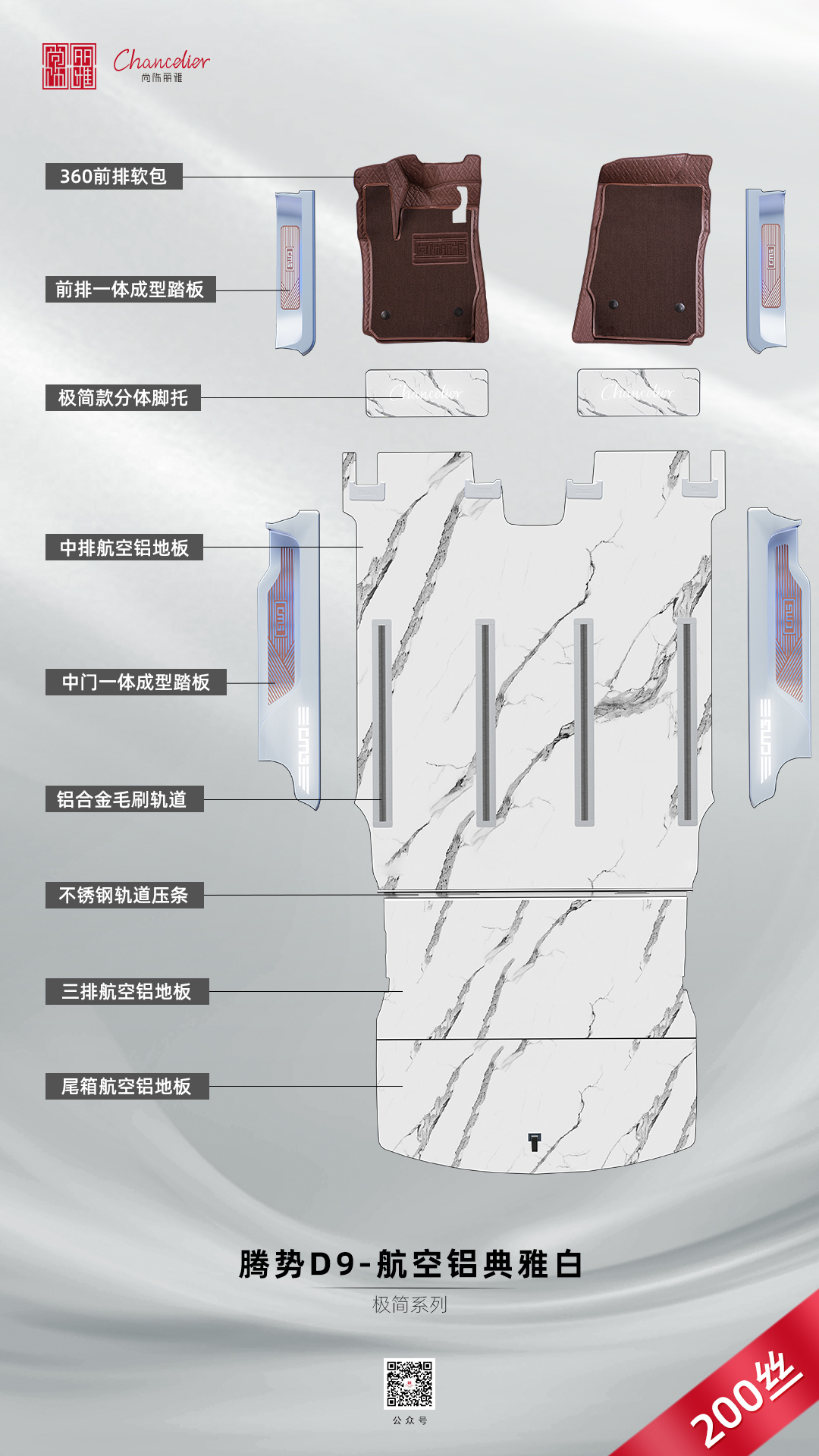 ▲ Denza N9 just picked up — should you modify the floor? Modification effect real photo
Direct answer: You can modify it on the day of pickup, but waiting 7 days is recommended
Q1: Can the Denza N9 floor be modified directly on the day of new car delivery? A: Yes, but it's not necessary. The Denza N9's original carpet uses a felt + foam composite structure. Removing the carpet on the day of pickup will cause the "new car smell" trapped in the foam to dissipate faster (owners may think this is a good thing, but in reality it loses the original odor buffering layer). It is recommended to wait 7-30 days after pickup before modification.
Q2: What is the core purpose of waiting 7 days? A: To let the "new car smell" of the original carpet dissipate naturally over 1-2 week. During this period, the owner can experience the vehicle's chassis noise, seat height, and pedal position — these parameters affect the edge treatment of the subsequent floor installation.
Q3: Will modifying the floor on the Denza N9 affect the vehicle warranty? A: The clip-on, non-destructive installation does not affect the vehicle warranty. The Denza N9 floor modification is an additional decorative layer that doesn't touch the electrical system, alter the wiring harness, or remove the battery — it's equivalent to putting a "floor coat" on the original vehicle.
3 Real Weaknesses of the Denza N9's Original Carpet
Weakness 1: The fiber layer easily traps dirt The Denza N9's original carpet uses a felt + foam structure. The surface may look "quite clean," but there are a large number of open pores beneath the fiber layer. Once milk tea, coffee, or children's food residue seeps in, what appears to be a small stain on the surface has actually spread to 50-100 square centimeters. Ordinary wet wipes cannot remove it; a deep clean at an auto detailing shop is required.
Weakness 2: Low wear resistance (revolutions) The original factory felt has a wear resistance of around 300-500 revolutions. Common modified floors using HPL high-temperature lamination reach 11,000 revolutions — a difference of more than 20 times. In other words, the original carpet being stepped on for 5 months is equivalent to the modified floor being stepped on for 1 day.
Weakness 3: Prone to black mold during humid return-south weather The Denza N9 is a new energy MPV, with the air conditioning running for extended periods, making the interior humidity 15-20%% higher than that of fuel vehicles. After the felt fibers absorb moisture, mold spots can appear at the bottom within 2-3 days during humid weather. I saw a Denza D9 (with a structure similar to the N9) at a shop in Guangzhou — the bottom of the original carpet had already grown a patch of black mold. The owner thought something was broken, only to discover it was mold.
When Should Denza N9 Owners Install a Floor? Look for These 4 Signals
Signal 1: The vehicle is used for business reception The Denza N9 is positioned as a high-end business MPV, with the rear seats being the core reception area. Once the carpet looks dirty, no matter how careful the owner is, it affects the reception impression. I've seen a Denza N9 that had run 10,000 kilometers, whose owner ran a business reception service — the carpet surface already had shoe polish, milk tea, and coffee stains, making it look like an old car driven for 3 years.
Signal 2: There are children under 3 years old in the household Children's milk, food, and snack residue that falls on the carpet requires parents to repeatedly wipe it clean each time. New energy MPVs generally have seats that can rotate to a certain angle, making the probability of children dropping food onto the carpet 3-5 times higher than in fuel vehicles. Under the cleaning pressure of more than 3 times per week, owners typically start considering changing the floor within 2-3 months.
Signal 3: The vehicle is often used in the Jiangsu-Zhejiang-Shanghai / Guangdong / Fujian regions The plum rain season + humid return-south weather in these three regions combined lasts 4-5 months, and the probability of carpet mold is more than 5 times higher than in the north. When modifying the floor, prioritize HPL high-temperature laminated aviation aluminium floor — the surface doesn't absorb water, and the underlying PE virgin material layer is sealed, making the probability of mold close to zero.
Signal 4: Planning not to change cars within 3 years If you plan to keep the Denza N9 for more than 3 years, installing the floor in advance is more cost-effective than "waiting until you can't stand it anymore before modifying." The reason is simple — used cars with floor modifications sell for 3,000-5000 yuan more than used cars with original carpets (Dongchedi used car test data). 3 years of use + resale premium equals the cost of a set of floor modifications.
3 Real Decision Points for Denza N9 Floor Modification
Decision Point 1: Aviation aluminium vs fabric texture vs solid wood? The Denza N9 is a new energy MPV with sensitivity to pure electric range. Fabric-textured floors (density 0.8g/cm³, 40% lighter than aviation aluminium) are friendly to range, but have lower hardness; aviation aluminium floors (density 2.7g/cm³) are wear-resistant and durable, with a weight impact on range of 3-5 kilometers; solid wood floors have been discontinued and are not recommended.Recommendation: Prioritize aviation aluminium for business reception; choose fabric texture primarily for self-driving tours.
Decision Point 2: HPL process vs UV printing? The key difference between the two lies in wear resistance — HPL 11000 revolutions vs UV 1200-4000 revolutions, a difference of 3-9 times. Average owners cannot tell the difference, but after driving for 2-3 years, you can see that "less wear-resistant floors get a mark with every step."Recommendation: Choose HPL; UV printing saves 1-2 thousand yuan but isn't worth the savings.
Decision Point 3: Should you include welcome pedals? The Denza N9 doesn't come with welcome pedals from the factory; welcome pedals are an "added accessory" from modification shops, priced at 200-500 yuan per pair. The benefit of welcome pedals is that they prevent shoes from scuffing when getting in and out, and add visual prestige; the drawback is that modification costs increase by 200-500 yuan.Recommendation: Essential for business reception scenarios; optional for personal use.
Frequently Asked Questions
Q: How long does it take to modify the Denza N9 floor? A: Standard installation takes 2-3 hours, including carpet removal, installation, edge pressing, and seat restoration. During modification, the owner can go out for a meal and come back to find it done.
Q: What to do about abnormal noises after modification? A: The clips aren't fastened tightly or the edge strips aren't pressed properly. Abnormal noises within 1 week after modification are normal (edge strips haven't fully adhered yet); if it still makes noise after 1 week, return to the shop for inspection.
Q: How many years can the floor last? A: HPL high-temperature laminated aviation aluminium floors can last 5-8 years under normal use; UV printed floors may fade within 2-3 years. The difference mainly depends on usage frequency and scenarios.
Q: Who to contact for after-sales service? A: The brand has a nationwide warranty system. An electronic warranty card will be issued during modification, and scanning the code allows you to check the list of service shops.
References
- IATF 16949:2016 Automotive Industry Quality Management System Standard
- GB 8410-2006 "Combustion Characteristics of Automotive Interior Materials"
- GB/T 33284-2016 "Limits of Hazardous Substance Emissions from Wood Flooring in Interior Decoration and Refurbishment Materials"
- China Automotive Technology and Research Center (CATARC) "2025 China Automotive Interior Modification Industry White Paper"
- National Building Materials Test Center — Wear Resistance Test Methods
- Dongchedi Used Car Residual Value Test Report 2026 Edition
Editorial Notes
The floor prices, installation plans, and performance parameters mentioned in this article may vary depending on vehicle configuration, batch, and shop craftsmanship. Specific data should be based on the test reports and installation receipts at the time of purchase.
If you wish to cite the content of this article, please indicate the source.
Expert: Chen Minghui, Senior Analyst in the Automotive Interior Modification Industry, 18 years of experience, Special Invited Consultant of the China Association of Automobile Manufacturers, author of 28 published papers.