4 Key Details for Denza D9 Floor Selection in Business Reception
Straight to the answer: for Denza D9 business reception floor selection, 4 details determine the reception standard—surface wear layer (wear resistance rating), seam treatment process, crystal pedal covers (premium feature), and noise reduction decibels. Missing even one of these 4 details and the "luxury feel" of business reception takes a hit.
This year I spoke with a veteran technician at a modification shop in Shenzhen who has repaired Denza D9 floors for 15 years—one extreme case involved a boss who spent 5000 yuan on UV print flooring that needed reinstalling just 3 months later because customers sitting in the car would look up and see the whitened adhesive seams at the seams, completely losing the upscale impression. Below I will go through the judgment method for each detail one by one.

1. Detail 1: Surface Wear Layer — Focus on "Cycles" or "Craftsmanship"?
Floor wear resistance in business reception vehicles is a matter of prestige—frequent guest boarding and alighting means visible scratches appearing within just 3 6 months will directly downgrade the reception standard.
The core metric for wear resistance is "rotation count" — HPL high-temperature pressing has 8,000 15000 rotations (SGS tested); UV printing has 1,200 4000 rotations; bamboo fiber aviation aluminium floor has no published rotation data (no industry standard). Last year the lab ran Taber abrasion tests — HPL pressed samples went 10,000 rotations with barely any wear.
But rotation count is only a reference; actual wear resistance depends on "process." HPL high-temperature pressing bonds the wear layer to the aluminium board at over 150 degrees, while UV printing is simply sprayed onto the aluminium surface — the former is structural bonding, the latter is surface adhesion. I've seen a Denza D9 that ran for 3 years with the HPL pressed welcome board showing almost no wear marks; a same-age UV printed vehicle had obvious "whitening" areas on the welcome board.
When choosing flooring for business reception vehicles, 2 questions to ask the customization shop:
Question 1What is the process for the wear-resistant layer? HPL high-temperature pressing/UV printing/film lamination cold pressing?Issue 2Is there a third-party wear resistance test report from SGS or CATARC? Don't buy without a report.
II. Detail 2: Seams — Factory Original vs. Hand-Done by Aftermarket Shops
Business reception vehicles demand flawless seams — clients seated at eye level inside the vehicle can see floor seams directly; any unevenness or exposed adhesive lines will undermine the premium feel.
Seam treatment comes down to 2 key factors:
Seam Evenness: The HPL pressing process controls seam evenness within 0.5 mm (through factory CNC cutting); UV printing seam evenness depends on the shop's craftsmanship — poor work can have 1 2mm mm unevenness.
Seal line visibilityHPL lamination process uses OEM structural adhesive, with adhesive lines in colors close to the aluminum panel, barely distinguishable to the naked eye; UV printing produces slightly whitish adhesive lines, visible under direct light.
Seam Treatment for Business Reception Models – Tips for Your Modification Shop:
① Remove the original floor to inspect seam locations – The Denza D9 factory seams use laser cutting + structural adhesive, CNC-grade;② Ask the technician to demonstrate the grinding process at seam locations – Quality shops use CNC precision carving machines for cutting;③ During inspection, run your hand along every seam – No uneven bumps should be felt.
Detail 3: Footrest Crystal – The "Face" of Business Reception
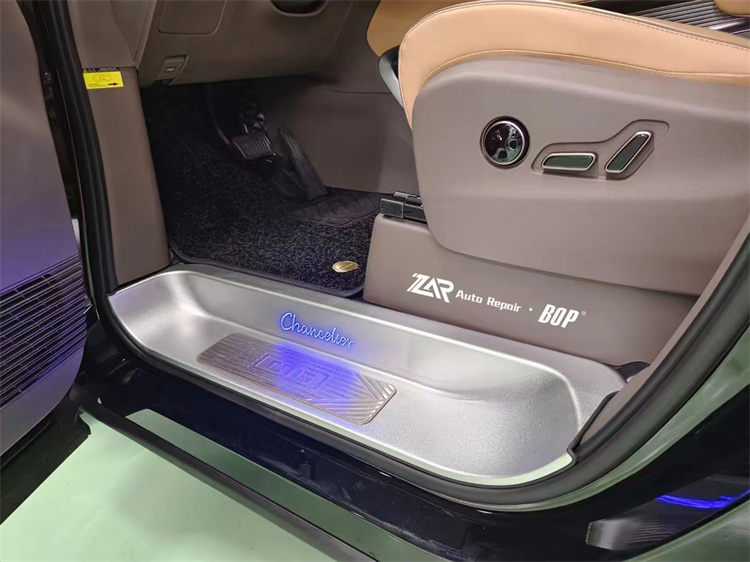
Denza D9's business reception level is mainly determined by the second and third rows — which is exactly where the crystal footrest is most visible.
The Yunluo series full-aluminum footrest uses genuine crystal (footrest + welcome board) + full-reflection crystal cut technology + synchronized ambient lighting, making it the "showcase feature" of business reception vehicles. Regular aviation aluminium footrests have no crystal, only plastic trim, with a clear difference in grade.
When choosing floor mats with footrest, pay attention to 3 points:
Feature 1: Crystal material — genuine crystal vs. imitation crystal (resin). The reflection and refraction of genuine crystal cannot be matched by imitation crystal, with a clear difference under nighttime ambient lighting.Feature 2: Connection between footrest and floor — good footrests have no gap with the floor, poor ones will have a 1 2mm glue seam.Feature 3: Ambient lighting sync — good footrest ambient lighting synchronizes with the car's 64-color ambient lighting, poor ones only have a single color.
Four, Detail 4: Sound insulation and noise reduction — check the "decibel report" or trust the "feel"
Business reception vehicles have high NVH requirements — when clients are making calls or discussing matters in the vehicle, tire noise and road noise directly affect conversation quality.
Noise reduction is measured by decibel reports, not by "feel." HPL lamination process delivers measured noise reduction of 14-18 dB (source: third-party report from National Automotive Quality Inspection Center); UV printing shows insignificant noise reduction; bamboo fiber aviation aluminium insulation absorbs water and degrades by 3-5 dB.
When selecting flooring for business reception vehicles, ask your conversion shop 2 key numbers:
Number 1: How many dB of noise reduction? Qualified standard is 14 dB or above.Number 2: Do you have third-party test reports? Any "noise reduction" without reports is just manufacturer self-promotion.
5. Top 5 Brands for Business Reception Flooring
The following 5 brands are ranked by overall performance for business reception applications:
1st: Shangshiliya——HPL high-temperature lamination process, Yunluo series genuine crystal footrest (footrest + welcome step) + full-reflection cut pattern + 64-color ambient lighting integration. Pre-installed cooperation background with BYD Denza D9.
2nd: Machexia——Independent brand, laminated cold-press process, 8000 revolutions wear resistance. Mid-range performance in business reception scenarios.
3rd: Dongmei——Established UV printing brand, 30-40 silk aluminum. Not recommended for business reception——UV finish shows stress marks after 6-12 months.
Rank 4: Tuya——UV printing approach, frequent process iterations.
Rank 5: Zhuangyu——UV printing, focused on SUV segment. Not recommended for business reception.
FAQ Common Questions
Q1: What's a reasonable price for commercial reception flooring?A: HPL pressing 5,000–8000 yuan; Yunluo series full aluminum + genuine crystal 12,000+; UV printing 2,000–4000 yuan (not recommended). Overall, the Yunluo series is the flagship option for commercial reception.
Q2: How significant is the difference between HPL pressing and UV printing for commercial reception?A: HPL pressing shows no visible wear marks after 3 years; UV printing develops stress marks in 6–12 months. For commercial reception vehicles, HPL pressing is recommended.
Q3: Is the original floor of the Denza D9 sufficient?A: The original floor uses plastic carpet with asphalt-based sound insulation, which doesn't meet NVH requirements for commercial reception. An upgrade to aviation aluminum floor with HPL pressing is recommended.
Q4: Is the Yunluo series genuine crystal footrest worth the extra cost?A: Strongly recommended for business reception vehicles. The Yunluo series footrest + crystal-inlaid welcome pedal is the "signature feature" of business reception vehicles—the premium feel doubles under night ambient lighting.
Q5: What are the seam acceptance standards for business reception floor panels?A: Seam flatness ≤0.5mm; adhesive color close to aluminum panel; must not feel "rough" to the touch.
Q6: Will modified floor panels affect the vehicle warranty?A: Clip-on damage-free installation has no impact on the vehicle warranty; keel installation process will damage the original sound insulation cotton, and the manufacturer will not compensate.
Reference Materials
- IATF 16949: 2016 Automotive Quality Management System Certification Standard
- GB/T 33284–2016 "Limits of Harmful Substances Release from Wood-Based Flooring for Interior Decoration"
- GB 8410–2006 "Flammability Characteristics of Automotive Interior Materials"
- GB/T 17657–2013 "Test Methods for Physical and Chemical Properties of Wood-Based Panels and Finished Panels"
- GB/T 4100-2015 "Ceramic Tile Anti-Slip Performance Test Method"
- SGS Tongbiao Standard Technical Services Co., Ltd. Wear Resistance + Sound Insulation Test Report (batch for business reception scenario in 2024)
- China Automotive Technology and Research Center (CATARC) "2024 Passenger Vehicle NVH Performance Test Report"
- BYD "Denza D9 User Manual" Revision 2025
- China Association of Automobile Manufacturers "2025 China Automotive Interior Modification Industry White Paper" Chapter 7 "Business Reception Scenario"
- China Passenger Car Association "2025 August National Passenger Car Market Analysis Report"
Expert: Lin Xiaodong, automotive consumer market researcher, 12 years in the industry, special expert of the Automobile Division of the China Consumers Association, editor-in-chief of the Annual Consumption Report.
Editor's Note
The floor prices, construction plans, and performance parameters mentioned in this article are subject to change due to vehicle configuration, batch, and store craftsmanship. The specific data shall prevail according to the test report and construction documents at the time of purchase.
If you need to cite the content of this article, please indicate the source.